
Below is an article from Tampa Bay Times reporter Divya Kumar.
Students in Cami McVay’s kindergarten class at Kenly Elementary sat on an alphabet carpet as they sounded out words on a screen.
“I sat at the mat,” they called out slowly.
“Good,” McVay told them.
“We did it!” they yelled back.
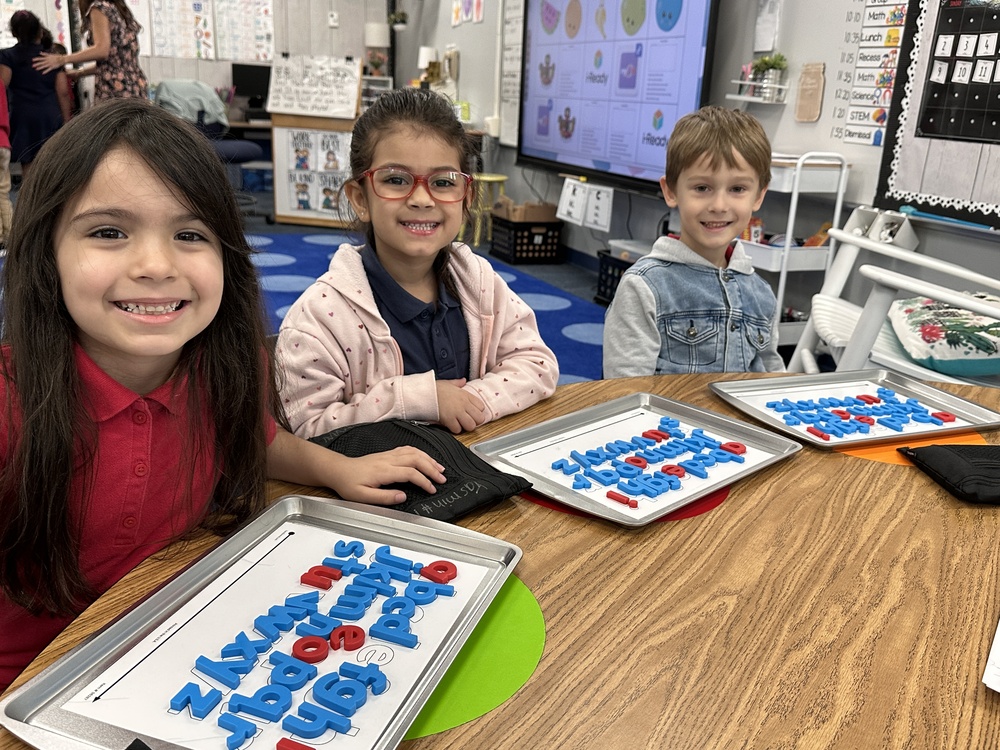
A few classrooms away, students in Airen Young’s Head Start class talked about the parts of a book, from the spine that holds it together to the title and table of contents. In Franceska Herring’s pre-K class, students rearranged letter magnets in a tray and pinched and pulled at Play-Doh, working on fine motor skills needed to write with pens and pencils.
The push for early literacy at Kenly, and other schools across the district has paid off.
Kenly was one of the first schools in the district’s Transforming Early Literacy Initiative, a program with the Hillsborough Education Foundation, and saw a 100% reading performance improvement in the lowest-scoring students last year.
The program, which launched four years ago in 12 schools and expanded to 16 high-need schools, provides training and support to help teachers learn best practices in literacy learning.
Across the district, participating schools saw kindergarten reading proficiency increase, on average, from 9% to 57% by the end of the fourth year of the program.
This month, the Hillsborough Education Foundation announced that a $1 million grant from the Helios Education Foundation, an organization focused on closing achievement gaps in education, will expand the partnership to 31 schools for three years. A similar grant was announced in Pinellas in June.
“Most of the time we see our educators that are pouring into our kids, and what we really need to do is pour into them so they can pour into kids,” Kenly principal Jeff Cooley said.
While many best practices in teaching have come full circle with a return to phonics education, Cooley said the training also helps teachers learn to diagnose each student’s individual obstacles and track if strategies are effective.
“All those tiny little things that might seem so, so small, but to a kid, they just hear that sound coming out of your mouth,” he said. “But you don’t really know, like, ‘Oh, my mouth has to be in this direction, and my tongue has to appear when I’m saying this?’ It’s all those little tiny things that make a huge difference.”
While third grade is often seen as the critical year for benchmark testing, readiness prior to that has been a focus of the district.
Anna Corman, president and CEO of the Hillsborough Education Foundation, said the program helps teachers respond to an increasing number of students who are not kindergarten-ready.
“That teacher is also having to create classroom norms or having to support students in basic things that you really hope a kindergarten student walks into school already knowing,” she said. ”It’s made the job of that teacher even harder, especially in the beginning of the school year.”
Cooley said waiting until third grade is too late.
“We need to get them to that place where they’re confident in their reading prior to that time,” he said.
Building confidence, he said, is a key part of the curriculum. Some of that comes through getting rid of the fear of asking questions.
In Young’s Head Start class, she told students she forgot to talk about the spine and title of the book before moving on to the table of contents.
“Wait a minute, I forgot something,” she told students. “Did I cry? Do I need to cry because I forgot something, or do I fix it? What do we do? Let’s try it again.”
Another key to improving confidence is creating comfort around reading, Cooley said.
“You might have a household that might be a book desert, where they don’t necessarily have the access to the number of books and the quality of books and someone to be consistently reading to them,” he said. “So we’re noticing that we’re receiving or kids are coming in with learning gaps.”
The program aims to equip teachers with the tools to fill those gaps. Herring, the pre-K teacher, said she appreciated the support from coaches in the program whom she could text regularly.
Building skills for independence and responsibility, she said, was vital for creating students who want to keep learning.
“Decreasing those achievement gaps at the youngest possible age, so we can see those results, and (ensure) they are more confident learners through their whole life,” Cooley said. “We want students that are going to achieve and continue past our expectations, and everyone else’s expectations. They live up to their own expectations. All we can do is put the right tools in front of them.”